|
|
|
|
home > products > brushware > safety > |
||||
|
|
|
||||
|
brushware safety |
|||||
|
► safety |
WARNING - failure to observe safety precautions may result in injury |
||||
| Safety goggles: |
Safety goggles or full face shields worn over safety glasses with side shields MUST BE WORN by all OPERATORS and OTHERS IN THE AREA of power brush operators. Comply with the requirements of ANSI Z87.1 "Occupational Eye and Face Protection." |
||||
| Guards: | Keep all machine guards in place. | ||||
| Speeds: |
Observe all speed restrictions indicated on the brushes, containers, labels, or printed in pertinent literature. "MSFS" means Maximum Safe Free Speed (R.P.M.) - spinning free with no work applied. For reasons of safety the "MSFS" should not be exceeded under any circumstance. |
||||
| Protective equipment: |
Appropriate protective clothing and equipment (such as gloves, respirator etc.) must be used where a possibility of injury exists that can be prevented by such clothing or equipment |
||||
| Warning: |
In normal power brushing operations, the material being removed, such as burrs, scale, dirt, weld slag, or other residue, will fly off the brush with considerable force along with the brush filaments which break off due to fatigue. The potential of serious injury exists for both the brush operator and others in the work area (possibly 50 or more feet from the brush). To protect against this hazard, before rotating the brush, operators and others in the area must wear SAFETY GOGGLES or FULL FACE SHIELDS WORN OVER SAFETY GLASSES WITH SIDE SHIELDS, along with PROTECTIVE CLOTHING for both the operator and all others within the area. You must follow all operator and safety instructions, as well as common safety practices which will reduce the likelihood or severity of physical injury |
||||
| Pressure: |
Avoid excessive pressure
when using a power brush. Excessive pressure causes over-bending of
the filament and heat build-up resulting in filament breakage, rapid
dulling, and reduced brush life. Instead of greater pressure on a
brush, it is suggested that you try: (1) a brush with a more aggressive
cutting action (increased wire size, decreased filament length, change to
a different brush type, i.e. knot type instead of crimped wire type), or
(2) higher speed (increased R.P.M., increased brush diameter.) |
||||
| Inspection and storage: |
Upon receipt, inspect brushes for damage, rust and deterioration . Store in original containers in a clean, dry location. Do not allow distortion of brush filaments/components or foreign matter to become lodged in brush face. |
||||
| Dust and fumes: |
Wear respiratory protection against this hazard (see ANSI Z88.2) |
||||
|
Instruction manual: |
Read the instruction manual of your tool (grinder) carefully before operation and follow it. |
||||
| Speed: |
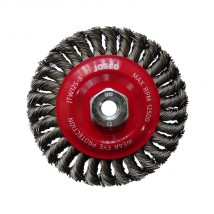
Make sure the maximum operating speed (Max. RPM) marked on the wire brush is at least as high as the "NO LOAD" speed shown on the name plate of the power tool. |
||||
|
Starting the brush: |
Before rotating the brush, during rotation, and until rotation stops, operators and others in the area must wear safety goggles, or full face shields over safety glasses with side shields. Brushes should be run at operating speed for at least one minute before applying work. Inspect for flutter or vibration that might be caused by poor installation or a damaged brush. During this time, no one is to stand in front of or in line with the brush. |
||||
|
Mounting brushes: |
Inspect brushes before mounting for damage, rust or other types of deterioration. Brush arbor hole and spindle diameter should be the same. Install the brush securely on the tool. |
||||
|
Brushing problems: |
Do not allow unsafe conditions to continue - occasionally, due to worn bearings, a bent spindle, an unusual application, operator abuse, or inappropriate use, a brush may fail. Do not use or continue to use a failed brush or one which is not functioning properly (i.e., throwing filaments out-of-balance, etc.) as this increases the possibility for further brush failure and hazard of injury . The cause of the failure should be evaluated and corrected. |
||||
|
© Copyright, Josco, 2003 | All rights reserved | Legal and Privacy Statements |
|